Indian-origin religions Hinduism, Jainism, Buddhism, and Sikhism,[4] are all based on the concepts of dharma and karma. Ahimsa, the philosophy of nonviolence, is an important aspect of native Indian faiths whose most well-known proponent was Shri Mahatma Gandhi, who used civil disobedience to unite India during the Indian independence movement – this philosophy further inspired Martin Luther King Jr. and James Bevel during the American civil rights movement. Foreign-origin religion, including Abrahamic religions, such as Judaism, Christianity and Islam, are also present in India,[5] as well as Zoroastrianism[6][7] and Baháʼí Faith[8][9] both escaping persecution by Islam[10][11][12] have also found shelter in India over the centuries.[13][14]
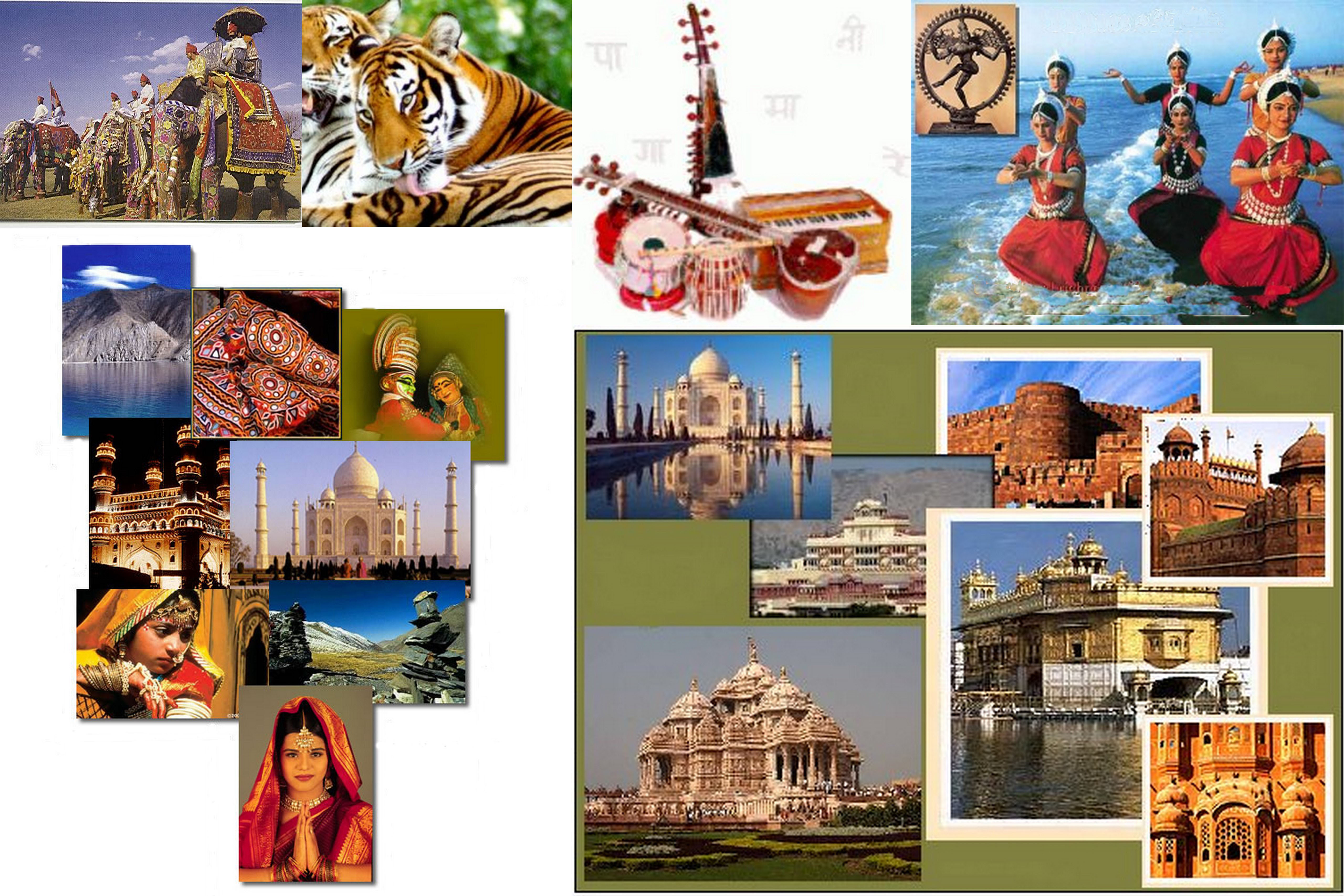
- India has 28 states and 8 union territories with different cultures and is the most populated country in the world.[15] The Indian culture, often labeled as an amalgamation of several various cultures, spans across the Indian subcontinent and has been influenced and shaped by a history that is several thousand years old.[1][2] Throughout the history of India, Indian culture has been heavily influenced by Dharmic religions.[16] Influence from East/Southeast Asian cultures onto ancient India and early Hinduism, specifically via Austroasiatic groups, such as early Munda and Mon Khmer, but also Tibetic and other Tibeto-Burmese groups, had noteworthy impact on local Indian peoples and cultures. Several scholars, such as Professor Przyluski, Jules Bloch, and Lévi, among others, concluded that there is a significant cultural, linguistic, and political Mon-Khmer (Austroasiatic) influence on early India, which can also be observed by Austroasiatic loanwords within Indo-Aryan languages and rice cultivation, which was introduced by East/Southeast Asian rice-agriculturalists using a route from Southeast Asia through Northeast India into the Indian subcontinent.[17][18] They have been credited with shaping much of Indian philosophy, literature, architecture, art and music.[19] Greater India was the historical extent of Indian culture beyond the Indian subcontinent. This particularly concerns the spread of Hinduism, Buddhism, architecture, administration and writing system from India to other parts of Asia through the Silk Road by the travelers and maritime traders during the early centuries of the Common Era.[20][21] To the west, Greater India overlaps with Greater Persia in the Hindu Kush and Pamir Mountains.[22] Over the centuries, there has been a significant fusion of cultures between Buddhists, Hindus, Muslims, Jains, Sikhs and various tribal populations in India.[23][24]
India is the birthplace of Hinduism, Buddhism, Jainism, Sikhism, and other religions. They are collectively known as Indian religions.[25] Indian religions are a major form of world religions along with Abrahamic ones. Today, Hinduism and Buddhism are the world's third and fourth-largest religions respectively, with over 2 billion followers altogether,[26][27][28] and possibly as many as 2.5 or 2.6 billion followers.[26][29] Followers of Indian religions – Hindus, Sikhs, Jains and Buddhists make up around 80–82% population of India.
India is one of the most religiously and ethnically diverse nations in the world, with some of the most deeply religious societies and cultures. Religion plays a central and definitive role in the lives of many of its people. Although India is a secular Hindu-majority country, it has a large Muslim population. Except for Jammu and Kashmir, Punjab, Meghalaya, Nagaland, Mizoram and Lakshadweep, Hindus form the predominant population in all 28 states and 8 union territories. Muslims are present throughout India, with large populations in Uttar Pradesh, Bihar, Maharashtra, Kerala, Telangana, Andhra Pradesh, West Bengal and Assam; while only Jammu and Kashmir and Lakshadweep have majority Muslim populations. Christians are other significant minorities of India.


No comments:
Post a Comment